Written by Nouman Zulfiqar BSc Dental Technology, Founder of Classic Dental Lab
If you are a dentist searching for an NHS dental laboratory UK partner, you may wonder how NHS laboratory work differs from private dental laboratory work. The main differences relate to the treatment pathway, laboratory requirements, pricing structure, materials, case specifications and the level of flexibility available to the practice.
At Classic Dental Lab, based in Folkestone, Kent, we support both NHS and private dental practices across the UK. Our laboratory provides restorative and prosthetic work through traditional and digital workflows, with cases handled according to the individual prescription and clinical requirements.
NHS vs Private Dental Lab: What Is the Difference?
NHS dental laboratory work is carried out as part of an NHS dental treatment pathway, while private dental laboratory work is commissioned as part of private treatment; the laboratory requirements depend on the individual case rather than the NHS or private label alone.
For a dental practice, this distinction is important. An NHS case should not automatically be considered lower quality, and a private case should not automatically be considered higher quality.
The laboratory work should instead be based on the prescription, clinical requirements, materials, design, restoration type and patient’s treatment plan.
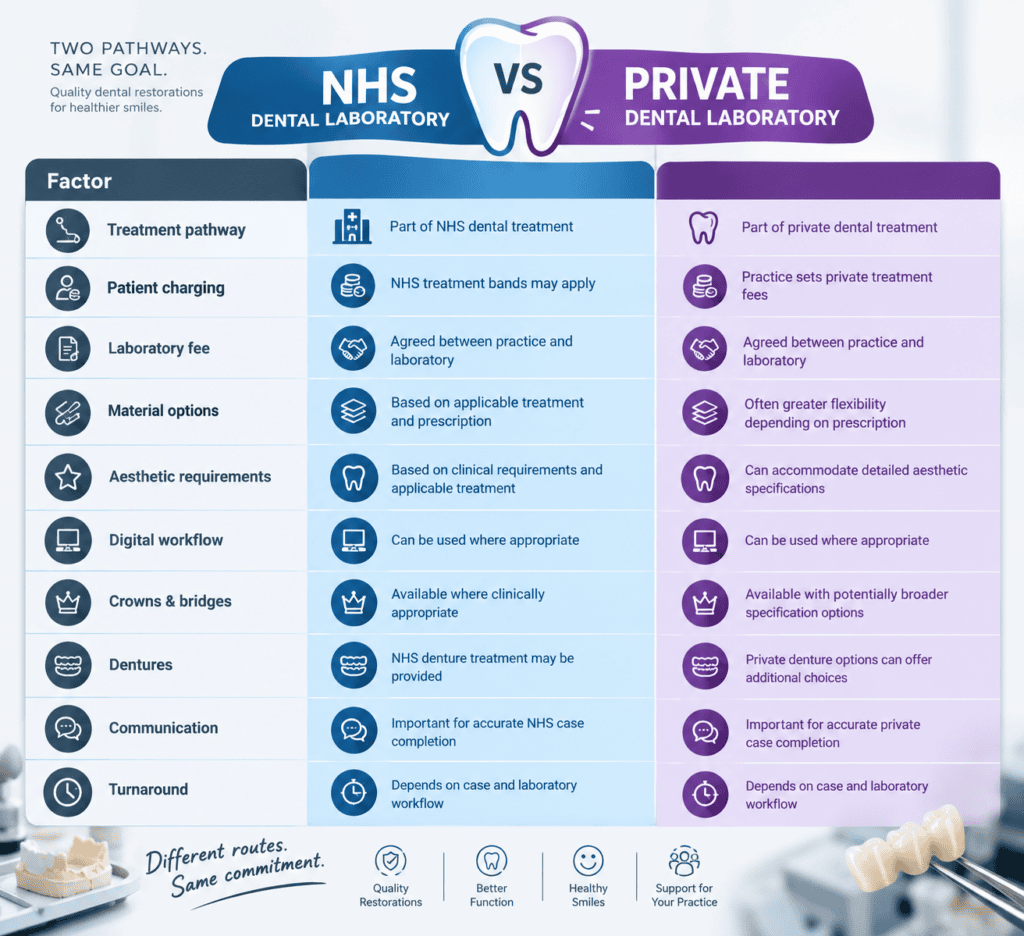
| Factor | NHS Dental Laboratory | Private Dental Laboratory |
| Treatment pathway | Part of NHS dental treatment | Part of private dental treatment |
| Patient charging | NHS treatment bands may apply | Practice sets private treatment fees |
| Laboratory fee | Agreed between practice and laboratory | Agreed between practice and laboratory |
| Material options | Based on applicable treatment and prescription | Often greater flexibility depending on prescription |
| Aesthetic requirements | Based on clinical requirements and applicable treatment | Can accommodate detailed aesthetic specifications |
| Digital workflow | Can be used where appropriate | Can be used where appropriate |
| Crowns & bridges | Available where clinically appropriate | Available with potentially broader specification options |
| Dentures | NHS denture treatment may be provided | Private denture options can offer additional choices |
| Communication | Important for accurate NHS case completion | Important for accurate private case completion |
| Turnaround | Depends on case and laboratory workflow | Depends on case and laboratory workflow |
The important point is that NHS vs private does not by itself determine the quality of a dental restoration.
What Is an NHS Dental Laboratory?
An NHS dental laboratory provides laboratory services for dental practices carrying out NHS treatment, with the laboratory work based on the prescription and requirements of the NHS treatment pathway.
NHS dental practices in England submit FP17 information to NHS Dental Services. NHSBSA explains that FP17 data records information including the patient charge collected, units of dental activity and treatment banding.
For dental practices, this means the laboratory is one part of a wider clinical and administrative workflow.
NHS laboratory work can include restorations and appliances such as:
- Crowns
- Bridges
- Dentures
- Other dental appliances
- Appropriate implant-related restorations
The specific laboratory work depends on the dentist’s prescription and the patient’s treatment requirements.
What Is an FP17 Dental Laboratory Case?
An FP17 is not a type of dental restoration or a special laboratory product; it is part of the NHS dental activity and claims process used in England.
NHSBSA states that providers submit FP17 forms detailing dental activity, and the information is checked for validity as part of the NHS Dental Services processing system.
This distinction is useful because searches for “FP17 dental laboratory” can sometimes create confusion between the NHS administrative process and the laboratory work itself.
The laboratory receives the prescription and case requirements from the dental practice and manufactures the required restoration or appliance accordingly.
What Is a Private Dental Laboratory?
A private dental laboratory provides laboratory work for privately commissioned dental treatment, often giving practices greater flexibility in treatment specifications and aesthetic requirements.
Private dental cases can involve many of the same restoration types as NHS dentistry, including:
- Zirconia crowns
- Porcelain fused to metal restorations
- Bridges
- Acrylic dentures
- Flexible dentures
- Chrome dentures
- Implant restorations
- Veneers
- Digital dentures
- Full-arch implant restorations
The difference is that private treatment can provide more flexibility around the treatment plan, material selection and aesthetic requirements, depending on the dentist’s prescription and the patient’s needs.
This does not mean every private restoration is technically superior to an NHS restoration. The appropriate restoration depends on the clinical situation and prescription.
NHS Dental Lab Kent: What Should Practices Look For?
An NHS dental lab in Kent should provide clear communication, appropriate laboratory processes, reliable turnaround information and the ability to work accurately from NHS and private prescriptions.
For practices searching for an NHS dental lab Kent, location is useful, but it should not be the only consideration.
A dental practice should also ask:
- Does the laboratory handle NHS and private cases?
- What restoration types are available?
- What materials are offered?
- What is the expected turnaround?
- Does the lab accept digital impressions?
- Which intraoral scanners can be connected?
- How are urgent cases handled?
- How does the laboratory communicate with dentists and practices?
- What happens if a case requires clarification?
- Does the laboratory provide collection and delivery options?
Classic Dental Lab in Folkestone, Kent
Classic Dental Lab is an MHRA-registered dental laboratory based in Folkestone, Kent, providing dental laboratory services to NHS and private dental practices across the UK. The laboratory’s website also states that its technicians are GDC-registered.
The laboratory provides crowns, bridges, flexible partial dentures, chrome dentures, acrylic dentures, implant-supported restorations, veneers, digital dentures and orthodontic appliances.
For practices looking for an NHS dental laboratory in Kent, Classic Dental Lab combines traditional laboratory craftsmanship with digital CAD/CAM workflows.
What Does a Dental Lab Need From an NHS Practice?
A dental laboratory needs a clear prescription, accurate patient and case information, appropriate records and any specific clinical or technical instructions required to manufacture the restoration.
Good communication between the practice and laboratory can help reduce avoidable delays.
For example, a prescription may need to communicate:
- Restoration type
- Tooth number or relevant site
- Material requirements
- Shade information
- Occlusal requirements
- Design instructions
- Implant system and components where applicable
- Patient-specific aesthetic requirements
- Required delivery date
- Relevant digital files or scans
If information is missing, the laboratory may need to contact the practice before proceeding.
This is particularly important for complex cases where the restoration requires coordination between the dentist and technician.
Digital Dentistry and Intraoral Scanner Compatibility
Digital case submission can make communication between a dental practice and laboratory more efficient by allowing digital impressions and case information to be transferred electronically.
Classic Dental Lab supports a broad range of digital workflows, including connections for systems such as 3Shape TRIOS, Medit, iTero, Dentsply Sirona, Panda, Aoralscan, Carestream Dental, Luanca, Aidite, Fussen, Dexis and Ivoclar Digital.
Rather than listing every scanner workflow in every article, practices can use the Classic Dental Lab digital dentistry and scanner connection information to check the available connection instructions.
Digital workflows can be particularly useful when a practice wants to:
- Send digital impressions
- Reduce physical impression shipping
- Transfer case information electronically
- Communicate digitally with the laboratory
- Integrate CAD/CAM workflows into routine case submission
The appropriate workflow will depend on the practice’s scanner and the type of case being submitted.
NHS vs Private Dental Laboratory: Does Quality Differ?
The NHS or private status of a case does not by itself determine laboratory quality; quality depends on the restoration requirements, materials, manufacturing process, technical accuracy and communication between the dental practice and laboratory.
This is one of the most important distinctions for dentists.
An NHS restoration still requires appropriate technical work. A private restoration also needs to meet the requirements of its prescription.
The difference may instead be in areas such as:
- Treatment eligibility
- Patient charging
- Material selection
- Aesthetic expectations
- Treatment planning
- Laboratory specification
- Additional cosmetic requirements
A laboratory should therefore assess every case according to its actual clinical and technical requirements.
NHS vs Private Dental Lab: Which Is More Suitable for Your Practice?
The most suitable dental laboratory is one that can meet your practice’s case requirements, communication needs, turnaround expectations and workflow—not simply one labelled NHS or private.
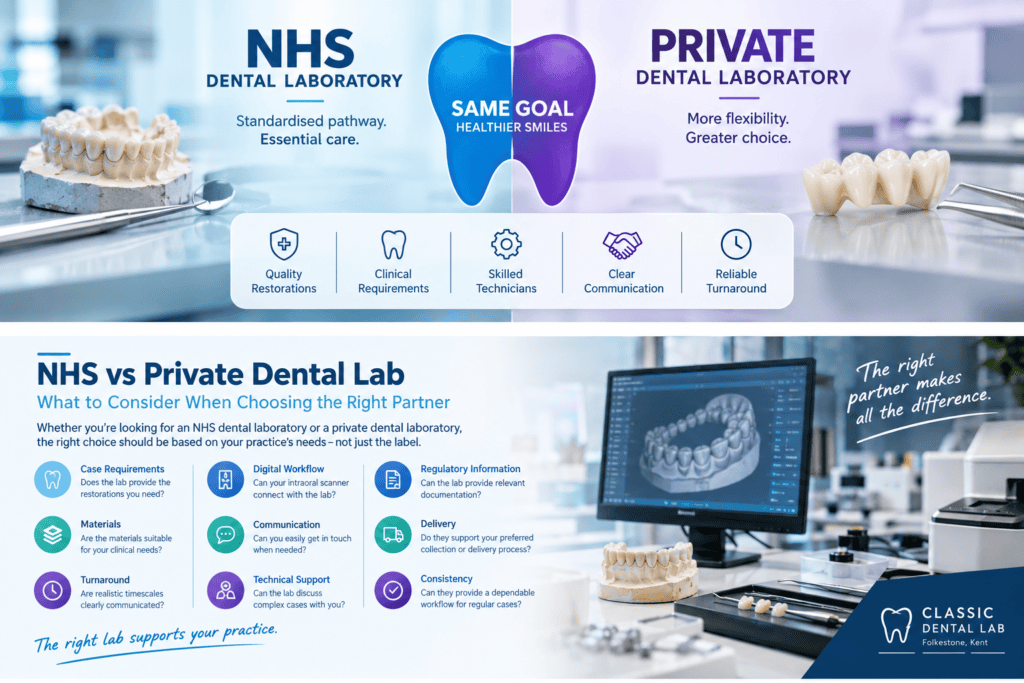
Before choosing a laboratory, consider the following:
- Case requirements – Does the lab provide the restorations your practice regularly prescribes?
- Materials – Are the materials appropriate for your clinical requirements?
- Turnaround – Are realistic turnaround times clearly communicated?
- Digital workflow – Can your intraoral scanner connect with the laboratory?
- Communication – Can you easily contact the laboratory team when clarification is needed?
- Technical support – Can the lab discuss complex cases with your practice?
- Regulatory information – Can the laboratory provide relevant documentation and information for applicable devices?
- Delivery – Does the laboratory support your preferred collection or delivery process?
- Consistency – Can the laboratory provide a dependable workflow for regular cases?
For NHS practices, these considerations can be more useful than simply comparing a laboratory’s price.
Why Choose Classic Dental Lab for NHS and Private Cases?
Classic Dental Lab supports NHS and private dental practices with restorative and prosthetic laboratory services from its Folkestone, Kent laboratory.
The laboratory states that it is MHRA-registered and works with GDC-registered dental technicians. Its services include crowns, bridges, dentures, implant restorations, veneers, digital dentures and orthodontic appliances.
Classic Dental Lab also supports both traditional and digital workflows, giving practices options for submitting cases according to their existing systems.
For dentists, the objective is straightforward: clear communication, accurate prescriptions, appropriate laboratory manufacturing and a dependable case workflow.
NHS vs Private Dental Laboratory: Key Takeaways
NHS and private dental laboratory work can involve many of the same restoration types, but the treatment pathway, charging structure and level of treatment flexibility can differ.
The key points are:
- NHS dental treatment follows an NHS treatment and charging framework.
- FP17 relates to NHS dental activity and claims processing, rather than being a specific type of laboratory restoration.
- NHS dental charges are different from laboratory fees.
- Private dentistry can provide greater flexibility depending on the treatment plan and prescription.
- NHS does not automatically mean lower laboratory quality.
- Private does not automatically mean higher laboratory quality.
- The dentist’s prescription and clinical requirements remain central to laboratory manufacturing.
- Digital dentistry can simplify case submission and communication.
- An NHS dental laboratory UK partner should be assessed on its workflow, technical capability, communication and ability to meet practice requirements.
- Classic Dental Lab provides NHS and private laboratory services from Folkestone, Kent.
Is an NHS dental laboratory different from a private dental laboratory?
An NHS dental laboratory provides laboratory work connected with NHS dental treatment, while a private dental laboratory provides work for private treatment. The actual laboratory requirements depend on the individual prescription and clinical needs.
Are NHS dental charges the same as dental laboratory fees?
No. NHS dental charges are patient charges for NHS dental treatment. A dental laboratory fee is a separate cost agreed between the dental practice and laboratory. NHSBSA lists the current 2026 NHS dental charges separately from laboratory arrangements.
What is an FP17 in NHS dentistry?
An FP17 is used in England to submit information about NHS dental activity. NHSBSA states that FP17 data includes information such as patient charges, units of activity and treatment banding.
Does NHS dentistry include crowns, dentures and bridges?
Yes. NHSBSA’s 2026 patient information identifies crowns, dentures and bridges among the more complicated treatments included within Band 3, subject to the applicable NHS treatment rules.
Does Classic Dental Lab provide NHS and private dental laboratory services?
Yes. Classic Dental Lab provides dental laboratory services for both NHS and private dental practices across the UK and is based in Folkestone, Kent.
Does Classic Dental Lab support digital intraoral scanners?
Yes. Classic Dental Lab provides digital connection workflows for multiple intraoral scanning systems, including 3Shape TRIOS, Medit, iTero, Dentsply Sirona, Panda, Aoralscan, Carestream Dental, Luanca, Aidite, Fussen, Dexis and Ivoclar Digital.
About the Author
Nouman Zulfiqar BSc Dental Technology is the founder of Classic Dental Lab, an MHRA-registered dental laboratory based in Folkestone, Kent, providing precision dental restorations—including All-on-4 and All-on-6 full-arch implant work—to NHS and private dental practices across the UK.
Contact Classic Dental Lab to discuss a case.