Written by Nouman Zulfiqar BSc Dental Technology, Founder of Classic Dental Lab
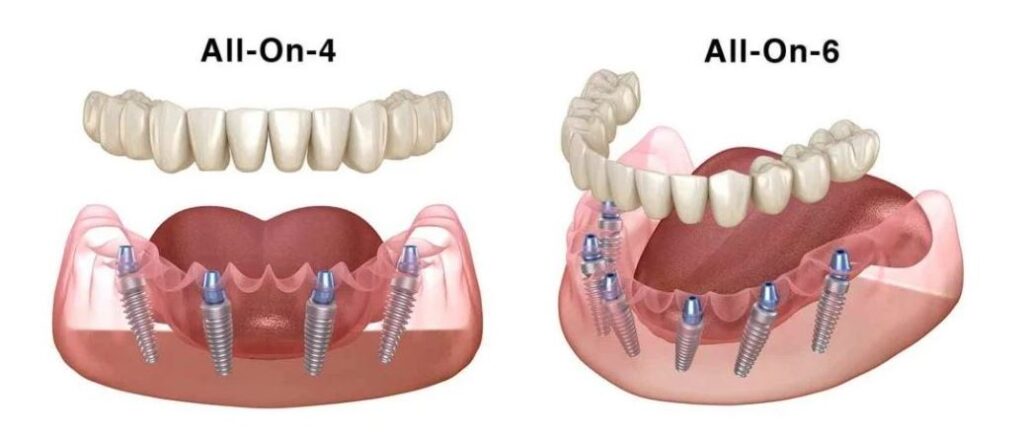
When a UK dental practice is planning full arch dental implants UK, All-on-4 and All-on-6 are two of the most commonly discussed approaches. The clinical decision about which treatment is appropriate belongs to the treating dental team and depends on the patient’s individual circumstances, implant position, available bone, treatment plan and other clinical factors.
But there is another important part of the process that is sometimes overlooked: the dental laboratory.
From the laboratory perspective, an All-on-4 or All-on-6 case is not simply a matter of producing a larger denture. It requires accurate communication, implant information, digital or conventional records, careful design, appropriate materials and a controlled manufacturing workflow.
For UK dental practices working with an All-on-4 dental lab UK partner, understanding these requirements can help make the restorative stage more predictable.
Quick answer: What is the difference between All-on-4 and All-on-6?
All-on-4 uses four implants and All-on-6 uses six implants to support a full-arch restoration, and neither option is automatically “better” — the right choice depends entirely on the patient’s individual clinical circumstances.
A recent systematic review and meta-analysis comparing All-on-4 and All-on-6 found broadly similar clinical outcomes overall, while also noting heterogeneity between studies and the need to interpret the findings cautiously.
From a laboratory perspective, the key question is therefore not simply:
“Is All-on-4 better than All-on-6?”
Instead, the laboratory asks:
“What restoration has been prescribed, what implant information is available, and what design and manufacturing process will produce an accurate, functional and maintainable prosthesis?”
All-on-4 vs All-on-6: The laboratory perspective
From a laboratory perspective, an All-on-4 or All-on-6 case is a structured process of records, design and manufacturing — not simply a bigger denture.
The laboratory becomes particularly important once implant placement and the restorative prescription have been established. An implant-supported full-arch restoration may involve several stages, including:
- Receiving the clinical prescription
- Reviewing implant and abutment information
- Receiving impressions or digital scan data
- Verifying implant positions
- Designing the restoration
- Selecting the prescribed restorative materials
- Manufacturing the framework or prosthesis
- Checking fit, contacts, occlusion and aesthetics
- Returning the restoration to the dental practice for clinical try-in or fitting
The exact workflow varies depending on the case, implant system, restoration design and whether the case is provisional or definitive.
What does the dental laboratory need for an All-on-4 or All-on-6 case?
The laboratory needs complete digital or conventional records, accurate implant information and a clear prescription before it can design and manufacture the restoration.
Good communication between the dentist and laboratory is essential. For a digital case, the laboratory may require information such as:
- Intraoral scan files
- Implant positions
- Scan bodies
- Implant system and component information
- Opposing arch scan
- Bite registration
- Prescription and design instructions
- Shade information
- Photographs where appropriate
- Provisional or existing restoration information
- Desired material
- Soft-tissue and aesthetic requirements
- Information about the intended restorative stage
The exact records required depend on the implant system and the restoration being prescribed.
The GDC Standards for the Dental Team emphasise effective communication and teamwork between dental professionals, including making sure colleagues understand what they are being asked to provide and working together in the patient’s interests. That principle is particularly relevant to complex implant laboratory work.
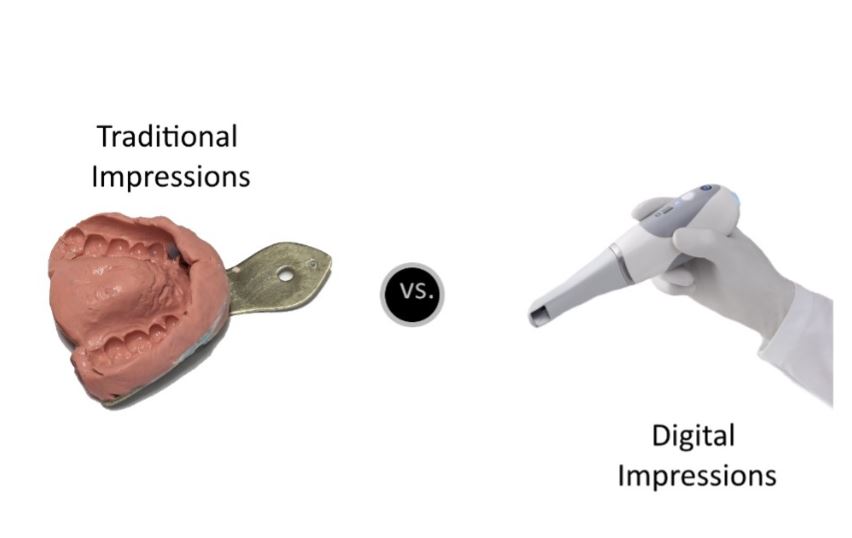
Digital impressions vs conventional impressions: which scanners does Classic Dental Lab accept?
Classic Dental Lab runs a digital implant workflow UK-wide and accepts scan data from 12 major intraoral scanning systems, so most UK practices can send a full-arch case without needing a conventional impression.
Digital workflows have changed how many implant cases are transferred between dental practices and laboratories. Instead of sending a physical impression, a practice can send digital scan data to the laboratory.
At Classic Dental Lab in Folkestone, Kent, we accept digital impressions from the following intraoral scanning systems:
- 3Shape TRIOS
- iTero
- Medit i500 / i700
- Dentsply Sirona Primescan
- Dentsply Sirona CEREC Omnicam
- Carestream CS 3600
- Carestream CS 3700
- Planmeca Emerald
- Straumann Virtuo Vivo
- Shining3D Aoralscan
- 3M True Definition
- Dentsply Sirona DWIO
A digital workflow can make transferring case information between the practice and laboratory more efficient. However, the quality of the final restoration still depends on the quality of the clinical records, scan strategy, implant components, prescription and laboratory process.
Digital does not automatically mean accurate. For full-arch implant cases, the laboratory needs usable scan data and the correct implant-related information before the restoration can be designed and manufactured.
What materials are used for All-on-4 and All-on-6 restorations?
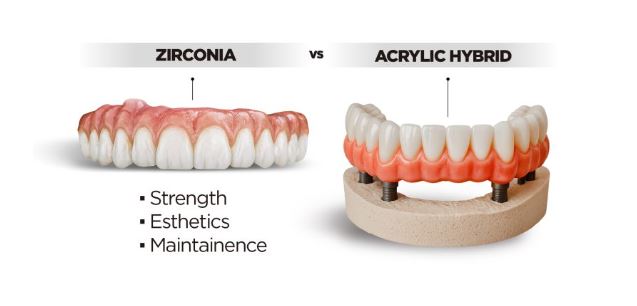
Material choice for an All-on-4 or All-on-6 restoration — whether PMMA, zirconia, or an acrylic hybrid — is determined by the clinical prescription and treatment stage, not by laboratory preference.
The material depends on the prescribed restoration and treatment stage.
Provisional restorations (PMMA dental lab UK)
A provisional full-arch restoration may be produced using materials such as acrylic or PMMA-based materials. As a PMMA dental lab UK practices can rely on, Classic Dental Lab produces provisional restorations that follow the dentist’s prescription and the agreed treatment plan.
The purpose of a provisional restoration can differ from case to case. It may allow the clinical team to evaluate factors such as:
- Tooth position
- Aesthetics
- Phonetics
- Occlusion
- Patient comfort
- Soft-tissue considerations
Definitive zirconia restorations (zirconia implant crown lab)
Zirconia can be used for definitive implant-supported restorations, including a zirconia implant crown, where it is clinically prescribed and appropriate for the case. A zirconia full-arch restoration can be digitally designed and manufactured with careful consideration of:
- Framework design
- Implant interfaces
- Occlusion
- Tooth proportions
- Emergence profile
- Soft-tissue aesthetics
- Material thickness
- Connector and framework requirements
However, zirconia is not automatically the right choice for every All-on-4 or All-on-6 case. Material selection should be based on the clinical prescription, implant system, restorative design and individual case requirements, and this also applies to dental implants bridge restorations more broadly.
Acrylic and hybrid designs (implant supported denture)
Some full-arch implant restorations use acrylic teeth combined with an appropriate framework or supporting structure — often described as an implant supported denture. These designs can be useful where the clinical team requires a particular combination of aesthetics, repairability, weight, cost and restorative flexibility.
Again, the laboratory should manufacture according to the prescribed design rather than selecting a material solely because it is popular.
All-on-4 vs All-on-6: quick comparison table
The table below summarises how All-on-4 and All-on-6 typically differ from a dental laboratory perspective — it is not a clinical recommendation, and the treating dental team decides which is right for each patient.
| Aspect | All-on-4 | All-on-6 |
| Number of implants | Four implants support the full-arch restoration | Six implants support the full-arch restoration |
| Typical framework span | Slightly shorter cantilever/span considerations for the lab to manage | Additional implant interfaces for the lab to align across the arch |
| Digital workflow | Compatible with standard digital implant workflows | Compatible with standard digital implant workflows |
| Provisional stage | Often produced in acrylic or PMMA, per prescription | Often produced in acrylic or PMMA, per prescription |
| Definitive material options | Zirconia, acrylic/hybrid — per prescription | Zirconia, acrylic/hybrid — per prescription |
| Lab turnaround driver | Depends on scan quality, components and design — not implant count alone | Depends on scan quality, components and design — not implant count alone |
Does All-on-6 take longer for a dental laboratory than All-on-4?
Not necessarily — turnaround depends on scan or impression quality, implant components, framework design and materials, rather than on implant count alone.
Turnaround can be influenced by:
- Quality of the impression or scan
- Availability of implant components
- Implant system
- Framework design
- Restoration material
- Try-in requirements
- Occlusal complexity
- Shade and aesthetic requirements
- Changes requested during the case
- Whether the restoration is provisional or definitive
- Whether additional records are required
For this reason, it would be misleading to promise a fixed turnaround for every All-on-4 or All-on-6 restoration.
At Classic Dental Lab, our standard crown turnaround is 5–7 working days, while complex implant and full-arch cases are assessed according to their individual requirements. For a specific case, the best approach is to confirm the expected laboratory turnaround with the laboratory before sending the prescription.
Why accurate implant information matters
An implant-supported restoration depends entirely on the relationship between the patient’s implant positions and the laboratory’s digital or physical model, so accurate component information is essential.
A missing or incorrect component specification can create delays because the laboratory may need clarification before proceeding. For example, an implant case may require confirmation of:
- Implant manufacturer/system
- Implant position
- Scan-body information
- Abutment type
- Connection type
- Restoration design
- • Screw retained implant crown or other prescribed configuration
- Material
- Shade
- Occlusal requirements
For full-arch cases, these details become particularly important because multiple implant interfaces must work together within one restoration.
All-on-4 vs All-on-6: what should dentists consider when sending a case to the laboratory?
A well-documented prescription reduces unnecessary back-and-forth and helps the laboratory understand the intended outcome before work begins.
Before submitting a case, the practice should consider whether the laboratory has received:
✓ Complete digital scans or appropriate impressions
✓ Opposing arch information
✓ Bite registration
✓ Correct implant and scan-body details
✓ Prescription and restoration design
✓ Material requirements
✓ Shade information
✓ Relevant photographs
✓ Details of any provisional restoration
✓ Required delivery date, where applicable
This is particularly important for complex full-arch cases where several clinical and laboratory stages are interconnected.
Is All-on-4 better than All-on-6?
There is no universal answer — All-on-4 and All-on-6 are different treatment configurations, and the appropriate approach must be determined by the treating dental team based on the patient’s clinical situation.
Evidence comparing the two approaches does not support reducing the decision to the implant count alone. A 2026 systematic review and meta-analysis reported similar overall outcomes between the two approaches but also highlighted study heterogeneity and the need for cautious interpretation.
The laboratory’s role is different: once the treatment has been prescribed, the laboratory works with the dental practice to translate the clinical plan into an accurately designed and manufactured restoration.
The importance of the dentist-laboratory relationship
Complex implant dentistry works best when the dentist, implant team and laboratory communicate clearly and consistently throughout the case.
The GDC states that dental professionals should work effectively with colleagues and contribute to good teamwork in the interests of patients. It also emphasises working within professional knowledge and skills and using current evidence and authoritative guidance.
For a laboratory, that means asking questions when information is incomplete rather than making assumptions. For the dental practice, it means providing sufficient information for the laboratory to understand the prescription.
The result is a more structured workflow from clinical planning → digital records → laboratory design → manufacturing → clinical fitting.
Full-arch, implant bridge and All-on-4/All-on-6 services at Classic Dental Lab
Classic Dental Lab is an MHRA-registered dental laboratory in Folkestone, Kent, offering All-on-4 and All-on-6 implant restorations alongside a full implant bridge dental lab service for NHS and private practices across the UK.
Our services include implant restorations, All-on-4 and All-on-6 full-arch cases, and implant bridge dental lab work, alongside:
- Zirconia crowns
- PFM bridges
- Flexi dentures
- Chrome dentures
- Acrylic dentures
- Digital dentures
- Veneers
- Night guards
- Sports mouthguards
Our crown turnaround is typically 5–7 working days, while implant-supported full-arch restorations are assessed according to individual case requirements.
For UK dental practices looking for a laboratory partner for digital and implant workflows, visit our Services page for the full range, or contact our team to discuss laboratory requirements before a case is submitted.
Frequently Asked Questions
What is the main difference between All-on-4 and All-on-6?
All-on-4 generally uses four implants to support a full-arch restoration, while All-on-6 uses six. The appropriate option depends on the individual clinical treatment plan rather than implant number alone.
Does All-on-6 always provide a stronger restoration?
Not necessarily. Restoration performance depends on many factors, including implant positioning, prosthetic design, materials, occlusion, component selection and patient-specific factors. Implant number alone should not be presented as a guarantee of greater strength or longevity.
Can All-on-4 and All-on-6 restorations be made digitally?
Yes. Digital implant workflows can be used for many full-arch cases, provided the required scan data, implant information and prescription are available and suitable for the planned restoration.
Does Classic Dental Lab accept digital impressions?
Yes. Classic Dental Lab accepts digital impressions from 12 major intraoral scanning systems — see the full list above.
How long does an All-on-4 or All-on-6 restoration take?
There is no single turnaround time for every full-arch implant case. The timeframe depends on the restoration, materials, implant system, design, records and whether additional try-in or clinical stages are required. Classic Dental Lab’s stated crown turnaround is 5–7 working days; full-arch implant cases should be confirmed individually.
Who decides whether a patient needs All-on-4 or All-on-6?
The treatment decision belongs to the appropriately qualified clinical team responsible for the patient’s care. The dental laboratory’s role is to manufacture the prescribed restoration and work with the dental practice to support the restorative workflow.
For more common questions, see our full FAQ page.
Final takeaway
Successful All-on-4 or All-on-6 full-arch restoration depends on far more than implant count — accurate records, digital workflows, correct implant information, appropriate materials and clear dentist-laboratory communication all matter more.
The All-on-4 vs All-on-6 discussion is often presented as a simple comparison of four implants versus six. From a dental laboratory perspective, however, successful full-arch restoration involves much more than implant numbers.
Accurate records, reliable digital workflows, correct implant information, appropriate materials, careful CAD design and effective dentist-laboratory communication all contribute to a predictable restorative process.
For dental practices, choosing a laboratory that understands digital implant workflows and full-arch restoration requirements can be an important part of the overall treatment workflow.
Classic Dental Lab Folkestone — supporting UK dental practices with precision full-arch, implant bridge and All-on-4/All-on-6 restorations. Related reading: Zirconia vs PFM Crowns and What is a Dental Laboratory?.
About the author
Nouman Zulfiqar BSc Dental Technology is the founder of Classic Dental Lab, an MHRA-registered dental laboratory based in Folkestone, Kent, providing precision dental restorations — including All-on-4 and All-on-6 full-arch implant work — to NHS and private dental practices across the UK. Contact Classic Dental Lab to discuss a case.